
What Christian Writers Must Get Right About Conversion
What Christian Writers Must Get Right About Conversion
You can attend church.
You can serve.
You can even write Christian content.
And still not understand genuine salvation.
That sentence should cause concern—especially if you are a Christian writer.
Because when you write about faith, discipleship, repentance, or spiritual growth, you are not just crafting sentences. You are shaping theology in the minds of your readers. And if your understanding of genuine salvation is shallow, unclear, or sentimentalized, your writing will reflect it.
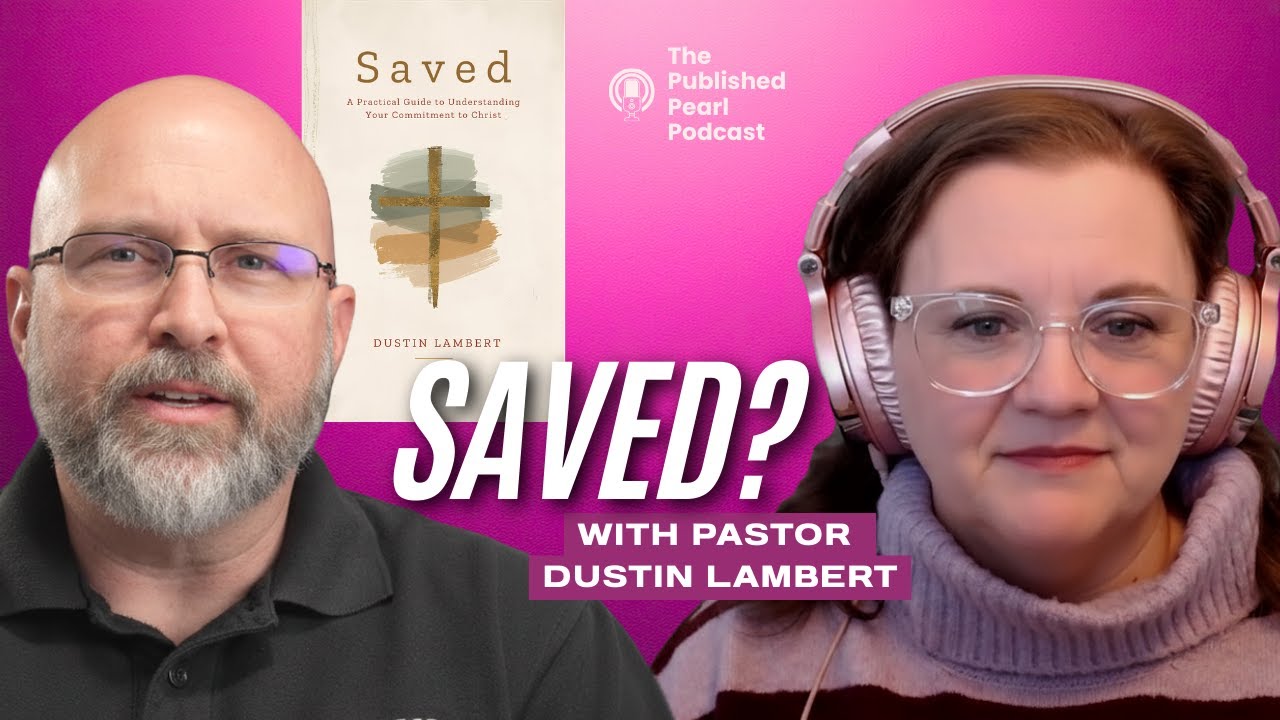
On a recent episode of The Published Pearl, I sat down with Pastor Dustin Lambert, Senior Pastor of Calvary Baptist Church, to talk about true conversion—what it is, what it is not, and why the church is struggling to recognize the difference, all of which he discusses in his new book Saved: A Practical Guide to Understanding Your Commitment to Christ.
For Christian writers, this conversation is not optional. It is foundational.
Genuine Salvation vs. Religious Familiarity
One of the central questions we wrestled with was this:
Can someone acknowledge Christ, attend church, and even serve… and still not be genuinely saved?
That question makes people uncomfortable. But discomfort does not make something untrue.
Dustin has pastored long enough to see a pattern: people who made emotional decisions at youth camps or revival meetings, but whose lives showed little evidence of transformation. They could point to a moment. They could recall a prayer. But they could not describe repentance. They were religiously active but spiritually unchanged.
Scripture warns us this is possible.
James 2:19 says, “You believe that God is one; you do well. Even the demons believe—and shudder.”
Mere intellectual agreement is not genuine salvation.
True conversion includes repentance and faith—a turning from sin and a turning toward Christ. It is not merely belief that Jesus exists. It is surrender to His lordship.
As Christian writers, we must be careful not to reduce salvation to a single emotional moment. If we do, we risk training readers to anchor their assurance in memory rather than in transformation.
The Problem of “Lostness” in the Church
Dustin described what he calls “lostness”—a condition where someone believes they are saved but lacks evidence of spiritual rebirth.
Second Corinthians 5:17 tells us, “If anyone is in Christ, he is a new creation. The old has passed away; behold, the new has come.”
New creation language implies change. Not instant maturity, but real, observable change.
In many Southern churches, cultural Christianity has blurred the line between genuine salvation and inherited religion. People grow up around faith language. They know the vocabulary. They can articulate doctrine. But knowledge of Christ is not the same as union with Christ.
As writers, we must resist the temptation to write for cultural Christians as if familiarity equals faith.
Clarity matters.
If we write devotionals, Bible studies, or books about spiritual growth without clearly articulating repentance and surrender, we may unintentionally affirm readers who have never truly bowed the knee.
That is not compassionate. It is careless.
Why Discipleship Is Not Optional
Another major theme in our conversation was the role of the church in biblical discipleship.
Dustin lamented how often professions of faith are celebrated, but discipleship is neglected. Decisions are counted. Follow-up is minimal. New believers are not trained in doctrine, church life, or spiritual disciplines.
Jesus did not command us to make converts. He commanded us to make disciples (Matthew 28:19–20).
Discipleship includes instruction. Correction. Community. Accountability.
You cannot separate Christ from His church.
One of the most telling lines from our conversation was this: You cannot claim to love Jesus while rejecting His bride.
If your writing encourages individual spirituality detached from church involvement, it may be unintentionally feeding a modern distortion of Christianity.
Christian writers must reinforce that genuine salvation produces a desire for fellowship, accountability, and growth within the local church.
Salvation Is a Free Gift — That Costs Everything
We also discussed a statement from another Rose & Pearl author: “Salvation is a free gift, but it is one that will cost you everything.”
That tension is biblical.
Ephesians 2:8–9 reminds us that salvation is by grace through faith—not a result of works. But Jesus also said in Luke 9:23, “If anyone would come after me, let him deny himself and take up his cross daily and follow me.”
Grace is free. Following Christ is costly.
For writers, this matters deeply. If we emphasize comfort over surrender, affirmation over repentance, or inspiration over obedience, we distort the gospel.
Genuine salvation reorders priorities. It confronts sin. It reshapes identity. It changes how we handle money, relationships, time, and ambition.
If your writing about Christianity does not include cost, it is incomplete.
What This Means for Christian Writers
If you write for believers—whether through books, blogs, devotionals, or Bible studies—you carry responsibility.
Here are three questions every Christian writer should wrestle with:
Do I clearly articulate repentance and faith, or do I assume them?
Does my writing point readers toward church involvement and discipleship?
Am I presenting salvation as transformation, or merely as comfort?
Your words may be discipling people you will never meet.
Genuine salvation is not about crafting a dramatic altar-call moment in your writing. It is about presenting Christ accurately—His grace, His lordship, and His call to surrender.
As Dustin’s book Saved: A Practical Guide to Understanding Your Commitment to Christ emphasizes, assurance should rest not in emotional memory but in ongoing fruit.
Not perfection. Fruit.
Not flawless obedience. Directional change.
Final Thoughts: Writing With Eternal Weight
Salvation is not a side topic. It is the foundation.
If we misunderstand genuine salvation, everything built on top of it—discipleship, spiritual growth, leadership, even publishing strategy—will be unstable.
Christian writers do not just produce content. We shape categories. We define terms. We clarify what faith means for our readers.
Write with depth.
Write with doctrinal clarity.
Write with the weight of eternity in mind.
Because when you steward the written word, you are not just building influence.
You are helping people discern whether they truly belong to Christ.
Watch our full conversation here.
If you’re unsure which kind of support your book needs right now, a Book Creation Strategy Session can help you discern the next step—before you spend money fixing the wrong problem. Schedule a time that works for you at https://roseandpearl.net/booking.
📖 Ready to stop circling the same book idea and actually start writing?
If you are at the beginning of the process and want help getting clear on what your book is about, who it is for, and how to start, The Write Start was created for you.
It will walk you through the foundational clarity every author needs before writing another chapter.
✍️Already writing, but struggling to stay consistent or finish?
If you know what you want to say but find yourself stuck, second-guessing, or starting and stopping, Write It Anyway is for the author who is ready to build momentum and complete the manuscript.
This is where clarity turns into pages.
🕊️Want ongoing guidance as you write and publish your book?
The Published Pearl Newsletter is where I share weekly insight on writing, publishing, and stewarding the message God has entrusted to you.
No noise. No pressure. Just thoughtful guidance for authors who want to write with purpose and integrity.
If this post encouraged you or helped you see your book more clearly, feel free to share it with someone else who is carrying a message they have been hesitant to write.
The Published Pearl exists to serve authors who believe their book is more than content. It is calling, stewardship, and obedience.
The Published Pearl is reader-supported. Some links may be affiliate links, which means we may earn a small commission at no additional cost to you.