
Is Writing a Book Worth It for My Business?
Is Writing a Book Worth It for My Business?
A Christian CEO’s Guide Before You Publish
You feel it. The nudge. The sense that it’s time.But as a Christian CEO, you’re not asking, “Can I write a book?” You’re asking something much more strategic:
Is writing a book actually worth it for my business?
You don’t have time for vanity projects. You’re stewarding revenue, team, clients, and calling. A book isn’t a hobby; it’s an investment.
So let’s talk about what you really need to know before you say yes.
1. A Book Will Not Magically Scale Your Business
There is an idea that circulates in Christian business spaces that sounds deeply spiritual and deeply comforting. It whispers that if God gave you the message, if He woke you up at 5:30 a.m. with the outline, if the words came through tears and prayer, then surely the book will carry itself once it’s live on Amazon.
I understand that instinct. When something feels assigned, it feels protected. When something is birthed in obedience, it feels inevitable.
But publishing is still a marketplace. And God has never operated apart from partnership.
Throughout Scripture, calling and construction walk side by side. Vision is given, and then labor follows. A word is spoken, and then obedience requires movement. Walls are still built brick by brick. Slings are still practiced with before giants fall.
He magnifies effort.
He directs strategy.
He opens doors.
He does not bypass stewardship.
Uploading a manuscript without a plan is not faith. It is optimism wearing church clothes.
Whether you self-publish or land a traditional deal, you will be responsible for selling your book. Traditional publishers are businesses. They expect you to arrive with an audience, with traction, with evidence that people are already paying attention. Self-publishing requires the same thing, except the infrastructure sits on your shoulders.
In both cases, without a marketing plan, your book becomes one more title among the millions released each year. That number is not dramatic flair. It is data.
Visibility is engineered.
And here is where I speak to you as a CEO, not as a hobbyist. You already understand positioning. You understand funnels. You understand that revenue follows clarity and distribution. You would never launch a high-ticket offer and simply hope it finds buyers through vibes alone.
Your book deserves the same level of strategic respect.
So the real question is not whether marketing will be required. It will. The deeper question is whether you are willing to market your book with the same intelligence and intentionality you bring to the rest of your business.
A book can accelerate authority.
It cannot replace strategy.
2. Book Sales Are Not the Primary ROI
Now we’re stepping into the part of the conversation that almost no one explains in public.
Book sales, by themselves, rarely create significant wealth.
That sentence can feel deflating if you’ve been staring at bestseller lists as the finish line. Traditional deals often come with modest advances. Royalty percentages are slim once you understand the math. Printing costs exist. Retailers take their percentage. Distributors take theirs. By the time the numbers settle, even a healthy sales run does not always translate into life-changing income.
And yet, that is not where the real power of a book lives.
The power is in positioning.
One of my authors — we’ll call her “T.” — came to me already established. She had the coaching credentials. She had the experience. What she lacked was amplification. She wanted to move from respected in her circle to undeniable in her niche.
Before her book ever released, doors started opening. She began booking top-tier paid speaking engagements. Event hosts introduced her differently. The language shifted. She was no longer simply a coach; she was an author.
Then the ripple effects began.
At events, she sold boxes of books at the back of the room. Not stacks — boxes. Women walked up after hearing her speak and said, “How do I work with you?” Her calendar reflected it. Her authority settled into something tangible.
The book did not replace her business.
It clarified it.
It concentrated it.
It gave people something to hold in their hands that reinforced what she already carried.
The book was never the product. It was the doorway.
I have watched authors sell in the hundreds and thousands in their first year and see far greater results through what those books activated — applications, consulting contracts, speaking invitations, premium programs. The SalesGirls recently shared an example that made the business world blink: 2,000 books sold translating into $1 million in backend revenue.
That kind of return does not happen because the book was wildly lucky.
It happens because the book was strategically aligned.
When the positioning is right, the math begins to multiply in ways that have very little to do with royalties and everything to do with leverage.
3. Audience Size Matters More Than You Think
If traditional publishing is your goal, there is a reality that needs to be faced early rather than painfully later: publishers are not evaluating how meaningful your message feels. They are evaluating market potential. In most cases, they are looking for evidence that you can move far more books than you assume. Ten times the sales you imagine would be “great” is often closer to what they need to see before they will even enter the conversation.
That means platform. Audience. Email list. Speaking traction. Proof that people are already raising their hands.
If you choose self-publishing instead, the requirements do not disappear. They simply move onto your shoulders. Selling beyond your immediate circle requires more than supportive friends and a loyal church community. It requires clarity about who the book is for and why it matters to them right now.
Without audience and positioning, a book experiences a predictable arc. It launches with enthusiasm. There is a flurry of early sales. Then the numbers stall. Not because the message lacks power, but because the distribution lacks intention.
I have sat with too many authors who were discouraged by self-publishing when the real issue was never the platform itself. It was the absence of strategy.
They wrote without professional editing, believing passion would compensate for polish. They skipped the hard work of positioning, assuming the reader would “get it.” They obsessed over book sales while never building a pathway beyond the final page. They did not articulate a next step. They did not clarify who the book was designed to serve. They never made it easy for the right reader to continue the relationship.
The result was frustration.
Not because self-publishing is broken. Not because the market is hostile. But because the book was treated as the destination instead of the introduction.
A book without a pathway is simply a printed idea.
A book with positioning becomes an authority engine.
4. Publishing Is an Investment (Here’s What It Really Costs)
Let’s talk numbers.
Professional editing averages around eight cents per word. For a 60,000-word manuscript, that alone comes to $4,800. Before a cover is designed. Before the interior is laid out. Before a single marketing asset is created.
ISBNs cost around $125. A professional cover design begins around $500 and increases based on the designer and complexity. Interior formatting typically starts around $750. Meaningful marketing support can begin at $2,500 and climb from there.
When you assemble the necessary pieces for a book that competes in today’s marketplace, you are easily looking at $6,000 or more.
That is not excess. It is the cost of quality.
Could you publish for less? Certainly. There are shortcuts available at every stage. Free ISBNs. Inexpensive covers. Unedited manuscripts. But your reader can feel the difference. So can event hosts. So can podcast producers. So can the clients you hope will pay you five figures.
If you self-publish without professional support, your sales will likely mirror the size of your immediate circle. The launch will feel encouraging. Your friends will celebrate you. Then momentum slows.
When you self-publish with strategy — proper editing, clear positioning, and a backend pathway — the results look different. Hundreds of copies become realistic. Thousands become attainable. The book begins to function as a lever, not a souvenir.
Traditional publishing shifts some of the production cost, but it does not eliminate responsibility. Publishers evaluate your platform before they evaluate your prose. They expect audience, momentum, and sales potential. A contract does not replace strategy.
So the decision in front of you is not whether you can produce a book at the lowest possible cost.
It is what kind of authority you intend to embody.
A book reflects your standards. It communicates whether you treat your message as a calling to steward or a task to complete. The marketplace reads those signals instantly.
You are not simply funding editing and design.
You are investing in the public version of your leadership.
5. The Wrong Book Will Attract the Wrong Clients
This is where I see the most heartbreak.
A woman spends months — sometimes years — crafting her manuscript. She revisits old wounds, refines her thinking, shapes her insight into something cohesive and vulnerable. The book releases, the launch comes and goes, and the results feel far smaller than the effort she poured in.
The disappointment is heavy because the work was sincere.
What was missing was not talent. It was architecture.
You already understand this principle inside your business. When messaging is slightly off, it creates friction. Conversations feel misaligned. The wrong people raise their hands. The right ones hesitate. Momentum slows, and it becomes difficult to identify why.
Books behave the same way.
When a book attempts to speak to everyone, it blends into the background. When it leans heavily into personal story without guiding the reader into their own transformation, admiration replaces action. When the tone feels instructional rather than invitational, readers close the cover informed but unchanged. When the final page offers no next step, the relationship ends the moment the book does.
I have worked with women who came to me discouraged after publishing on their own. They had done what they believed was required. They wrote honestly. They invested money. They launched faithfully.
Yet readers finished their book with no clear understanding of who it was for, what shift it created, or how to continue the journey with that author.
A book in the hands of a Christian CEO cannot afford to function as a beautiful memoir alone.
It must operate as a strategic asset.
It should refine your niche rather than blur it. It should anchor your authority so firmly that your name and your message become inseparable. It should introduce your framework so naturally that your paid offer feels like the obvious next step. It should extend the transformation you create beyond the room, the stage, or the Zoom call.
When those elements are present, a book attracts alignment. It filters. It clarifies. It multiplies.
When they are absent, even a well-written book struggles to carry the weight you hoped it would.
And for a woman stewarding influence, that difference is not small.
6. For a Christian CEO, This Is About Stewardship
This is the moment where discernment matters.
When a Spirit-led CEO looks across the table and says, “I feel called to write this,” I don’t rush to validate or rush to greenlight. Calling is sacred. It deserves examination, not enthusiasm alone.
So we slow down and look at the whole picture.
Is this the right season, or simply a strong desire?
Do you have the capacity to finish well, or are you already stretched thin?
Is there an audience prepared to receive this message?
Is there a backend structure that can steward the momentum the book creates?
Is the transformation you offer defined clearly enough to anchor a manuscript?
These are stewardship questions.
Obedience is not impulsive. It is aligned. It accounts for timing and readiness. It understands that influence is a responsibility, not a performance.
God multiplies what we steward well. That pattern runs throughout Scripture. Seeds are sown into prepared soil. Talents are entrusted to those who will invest them. Expansion follows faithfulness.
Publishing a book as a Christian CEO is rarely about chasing Amazon rank or collecting bestseller screenshots. It is about building something that outlives the launch window.
It is about legacy — what remains when the algorithm shifts.
It is about Kingdom impact — the kind that reaches women you will never meet.
It is about authority alignment — stepping fully into the leadership you already carry.
It is about multiplying transformation beyond your physical proximity, beyond the room, beyond the season.
If you sense a call to write, that matters deeply. That stirring is not accidental.
Calling and strategy do not compete with one another. They strengthen one another. When they move together, the result is not just a published book, but a positioned one — a work that carries both conviction and clarity into the marketplace.
So… Is Writing a Book Worth It for Your Business?
Here is the honest answer.
Writing a book is worth it when you are prepared to approach it as a strategic authority move. When you understand that it is not merely an act of expression but an act of positioning. When you see it as infrastructure — something that strengthens your brand, clarifies your voice, and extends your leadership beyond the limits of your calendar.
It becomes a wise investment when your messaging is clear, your niche is defined, and your offers are strong enough to carry the momentum the book will create. In that environment, a book functions as an accelerant. It deepens trust faster. It shortens sales cycles. It allows people to experience your thinking before they ever sit across from you.
It becomes frustrating when it is treated as a repair strategy. A book will not fix unclear messaging. It will not compensate for weak positioning. It will not substitute for backend structure that does not yet exist. If those foundations are unstable, publishing only magnifies the instability.
A book does not build a business from nothing.
It amplifies what is already there.
For many Christian CEOs, that amplification changes everything. It shifts introductions. It opens invitations. It reframes conversations. Rooms that once required explanation begin to recognize authority on sight. Doors that resisted hustle respond to clarity.
When alignment is present, a book becomes more than content. It becomes leverage.
And leverage, stewarded well, multiplies impact far beyond what effort alone can accomplish.
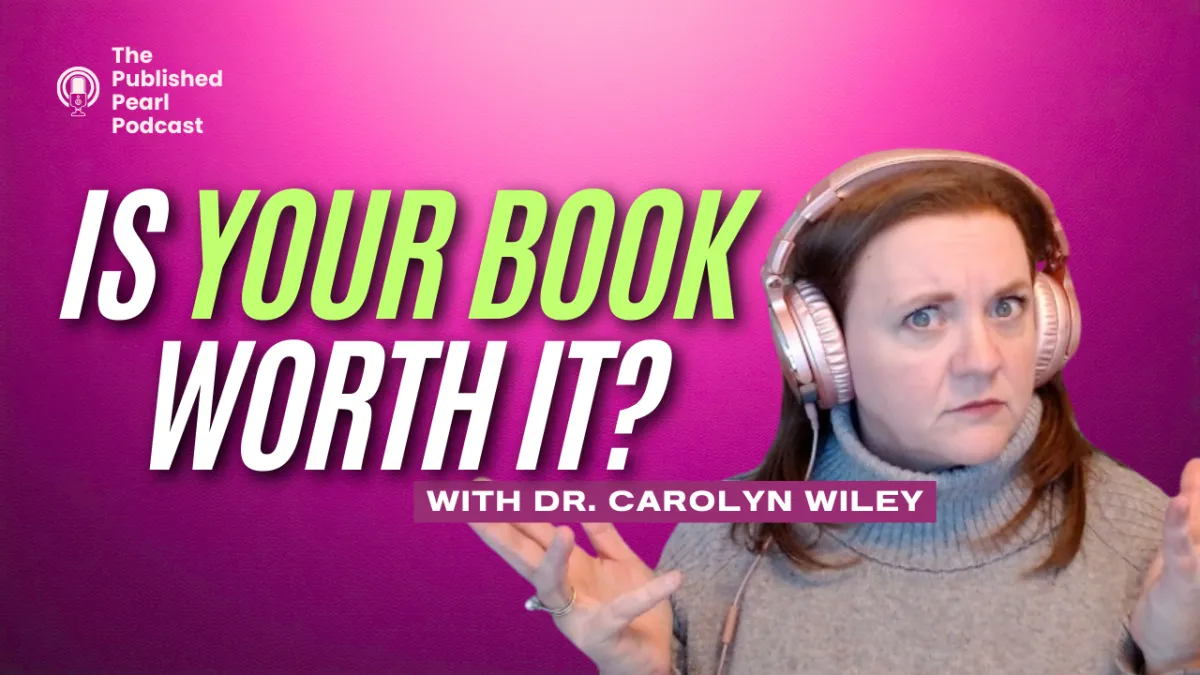
Watch the Full Breakdown on The Published Pearl Podcast
In this week’s episode of The Published Pearl Podcast, I expand this conversation beyond the blog and into the real-time discernment process every serious leader has to walk through.
We talk about what it actually feels like when the timing is right — not emotionally exciting, but strategically aligned. We talk about the red flags that signal delay, even when the desire is strong. We unpack how to distinguish between assignment and comparison, between obedience and industry pressure. And we walk through what must be built before you publish so that your book has something solid to stand on the moment it enters the world.
This is not a hype episode. It’s a clarity one.
If you are weighing whether writing a book is your next move, listen before you decide.
Your Next Step
If this conversation resonated with you, then take the next step.
Download the Getting Started Guide and walk through the framework I use with my own authors before we ever outline a chapter. It will help you evaluate readiness, alignment, and infrastructure with honesty instead of emotion.
📖 Download the Getting Started Guide here: The Write Start
If you would rather think it through together, schedule a clarity call. We will look at your positioning, your backend, your audience, and the actual role a book would play inside your ecosystem. No pressure. Just strategy.
📅 Book a clarity call here: https://roseandpearl.net/booking
You are already leading at a high level.
A strategically written book simply ensures the marketplace recognizes the authority you’ve been carrying all along.
✍️Already writing, but struggling to stay consistent or finish?
If you know what you want to say but find yourself stuck, second-guessing, or starting and stopping, Write It Anyway is for the author who is ready to build momentum and complete the manuscript.
This is where clarity turns into pages.
🕊️Want ongoing guidance as you write and publish your book?
The Published Pearl Newsletter is where I share weekly insight on writing, publishing, and stewarding the message God has entrusted to you.
No noise. No pressure. Just thoughtful guidance for authors who want to write with purpose and integrity.
If this post encouraged you or helped you see your book more clearly, feel free to share it with someone else who is carrying a message they have been hesitant to write.
The Published Pearl exists to serve authors who believe their book is more than content. It is calling, stewardship, and obedience.
The Published Pearl is reader-supported. Some links may be affiliate links, which means we may earn a small commission at no additional cost to you.